Dubai's grocery delivery landscape has shifted from scheduled supermarket runs to a constant stream of 15-90 minute deliveries from dark stores and hypermarkets. Meeting that speed without breaking the cold chain requires the right vehicles, tight route planning, and disciplined handling at every handoff point — from the picking floor to the customer's door.
March 2026 · 9 min read
Grocery Last-Mile Cold Chain in Dubai
How quick-commerce apps and supermarket delivery arms keep chilled and frozen groceries cold on the final leg from dark store to doorstep.
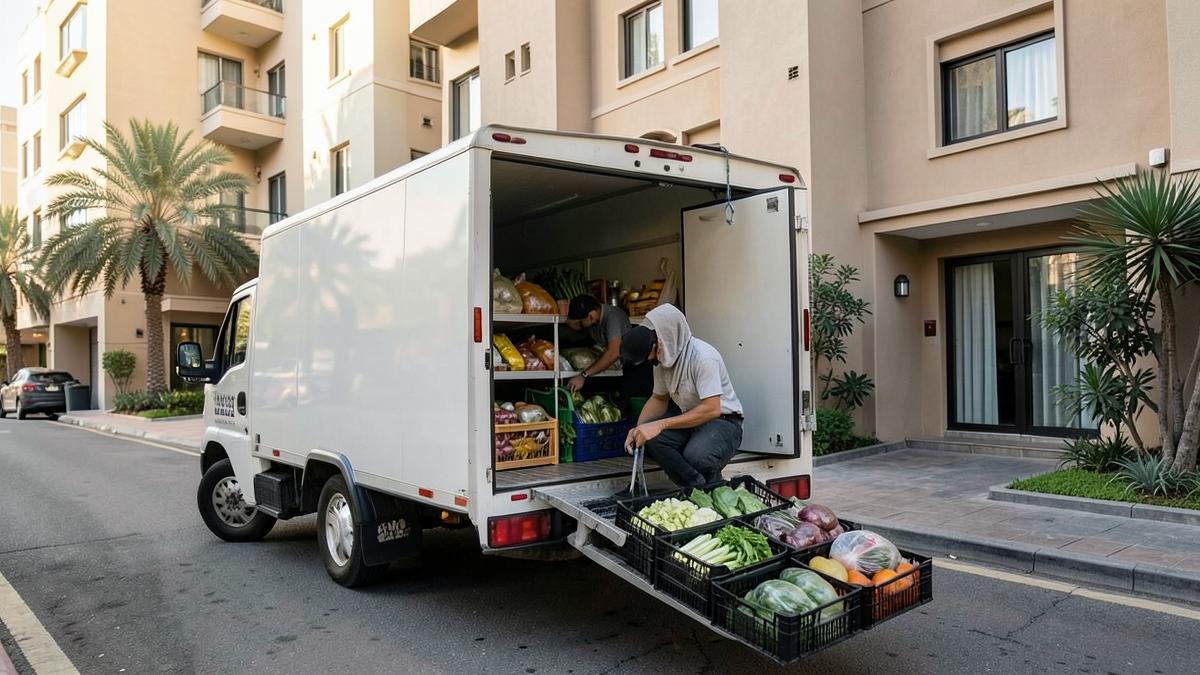
Grocery last-mile cold chain in Dubai means moving chilled and frozen orders from dark stores or supermarkets to doorsteps within 15-90 minutes, using dual-zone chiller vans, dense multi-drop routes, and continuous temperature logging to protect quality and meet Dubai Municipality food safety expectations.
Quick-Commerce Growth Is Rewriting Dubai Grocery Delivery
Dubai's quick-commerce sector has expanded rapidly, with grocery apps promising 10-30 minute deliveries alongside traditional supermarket e-commerce arms offering scheduled 1-2 hour windows. Both models depend on an unbroken cold chain from the dark store or hypermarket to the customer's door.
This growth has changed fleet requirements. Instead of a handful of large refrigerated trucks doing scheduled runs, operators now need many smaller chiller vans running continuous multi-drop loops throughout the day, each carrying a mix of ambient, chilled, and frozen items for dozens of customers.
Multi-Temperature Loads on a Single Van
A typical grocery basket includes ambient goods (rice, canned items), chilled products (dairy, produce, deli), and frozen items (ice cream, meat) in one order. Carrying all three on one van without a dedicated multi-zone setup risks the frozen items softening or the chilled items warming during longer routes.
Most last-mile operators solve this with insulated tote boxes and gel packs for smaller loads, or a partitioned dual-zone van body for higher volumes, keeping frozen at -18°C and chilled at +2°C to +5°C in separate compartments on the same vehicle.
- Frozen compartment: -18°C for ice cream, frozen meat, seafood
- Chilled compartment: +2°C to +5°C for dairy, produce, deli
- Ambient zone: unrefrigerated shelf-stable goods
- Insulated tote inserts for split orders within one drop
Dual-Zone Partitions and Vehicle Selection
Dual-zone chiller vans use a fixed or movable bulkhead to create two independently controlled temperature compartments within the same cargo box. This lets one van serve a route that mixes frozen and chilled orders without needing two separate vehicles or a second driver.
For high-volume dark stores, a 3-ton dual-zone van with a stronger refrigeration unit and better door seals holds temperature more reliably across a full shift of frequent door openings than a light van adapted with cool boxes.
Route Density and Drops Per Hour
Last-mile grocery economics depend on drops per hour, not distance covered. Dense residential clusters in Dubai — Marina, JVC, Business Bay, Deira — allow 8-12 drops per hour with a compact chiller van, while spread-out villa communities may only support 4-6.
Route planning software groups orders by proximity and delivery window, sequencing drops so the shortest-shelf-life items (frozen, dairy) are delivered earliest in the loop and the van's door stays closed as much as possible between stops.
Door-Open Losses in Dubai Summer
Every door opening in a Dubai summer afternoon lets in air at 40°C+, and the refrigeration unit needs several minutes to recover the internal temperature. On a route with 10+ stops, cumulative door-open time can be the single biggest driver of temperature excursions.
Operators reduce this by pre-sorting each drop's items into a single tote before the route starts, using rear curtain strips on the cargo door, and briefing drivers to minimize the time the door stays open at each stop.
Packaging: Gel Packs vs Active Refrigeration
For short 15-30 minute delivery windows, well-insulated bags with gel packs can maintain safe temperatures without a refrigerated vehicle at all — this is common for quick-commerce apps using scooters or small cars for the final mile.
For longer routes, larger baskets, or extended droptime windows, active refrigeration in a proper chiller van is necessary because passive packaging loses its cooling capacity within an hour or two, especially in high ambient heat.
Temperature Logging for Trust and Compliance
Customers increasingly expect proof that frozen and chilled groceries stayed cold in transit, and Dubai Municipality food safety guidance expects delivery operators to demonstrate temperature control for perishable goods. IoT temperature loggers fitted to chiller vans record continuous data that can be shared with customers or auditors on request.
This logged data also protects operators from unfair complaints — if a customer reports a warm delivery, the logger can confirm whether the compartment stayed within range for the entire route.
Handling Failed and Delayed Deliveries
Not every delivery is completed on the first attempt — customers may be unavailable, addresses may be wrong, or traffic may delay a route. Grocery items sitting in a stationary van without power risk spoilage faster than items in motion with the refrigeration unit running.
Best practice is keeping the engine or auxiliary refrigeration unit running during short waits, calling the customer immediately on a failed attempt, and building a short buffer stop into the route to return failed-delivery items to a chilled holding point rather than carrying them for the rest of the shift.
Dark Store to Doorstep: The Full Flow
A typical flow starts with picking in a temperature-controlled dark store or supermarket back-of-house area, staging orders in a chilled holding zone, loading into the van in the correct compartment, and running the sequenced route with minimal door-open time before final handover at the customer's door.
Each handoff point — pick, stage, load, transit, deliver — is a place where temperature discipline can break down, so operators that map and monitor the whole flow see fewer complaints than those that only focus on the vehicle.
Fleet Sizing: Rental vs Owning for Scaling Operators
Grocery delivery volumes swing sharply with promotions, weather, and seasonal demand (Ramadan, back-to-school, summer). Renting chiller vans lets operators flex fleet size up for peak periods without carrying idle owned assets during quieter months.
Many quick-commerce and supermarket delivery operators in Dubai use a core owned fleet sized for average demand, supplemented by short-term or monthly chiller van rentals to cover peaks, new dark store launches, or vehicle downtime — avoiding both under-capacity during rushes and over-investment in idle vehicles.
Delivery Model, Vehicle Type, and Route Profile
| Delivery Model | Vehicle Type | Temperature Zones | Typical Drops per Route |
|---|---|---|---|
| Quick-commerce (10-30 min) | Insulated bags / scooter box | Single zone, passive cooling | 1-2 |
| Dark store grocery (30-90 min) | Light dual-zone chiller van | Chilled + frozen compartments | 6-12 |
| Supermarket scheduled e-commerce | 3-ton dual-zone chiller van | Chilled + frozen + ambient | 10-20 |
| Bulk/wholesale grocery restock | 3-5 ton single-zone chiller van | Single zone, chilled or frozen | 2-5 |
Drop counts vary with route density, order size, and traffic conditions across Dubai.
Frequently Asked Questions
How do grocery delivery vans keep frozen and chilled items separate?
They use either a partitioned dual-zone van body with independently controlled compartments, or insulated tote boxes with gel packs that separate frozen and chilled items within a single-zone vehicle.
What temperature should grocery delivery vans maintain?
Chilled sections typically run +2°C to +5°C for dairy and produce, while frozen sections run at -18°C for ice cream, meat, and seafood, in line with standard cold chain practice.
How many drops can a chiller van complete per hour in Dubai?
In dense areas like Marina, JVC, or Business Bay, a compact chiller van can typically complete 8-12 drops per hour; spread-out villa communities usually support 4-6.
Do quick-commerce apps need refrigerated vehicles?
For very short 10-30 minute delivery windows, insulated bags with gel packs are often sufficient, but for longer routes or larger grocery baskets, an active chiller van is needed to maintain safe temperatures.
How is temperature data proven to customers?
IoT temperature loggers fitted inside the van record continuous readings throughout the route, which can be shared with customers or reviewed if a complaint arises about product temperature.
What happens to grocery items if a delivery fails?
Best practice is to keep refrigeration running during any wait, attempt to contact the customer immediately, and return undelivered chilled or frozen items to a chilled holding point rather than carrying them for the rest of the shift.
Should grocery delivery operators rent or own their chiller vans?
Most scale a core owned fleet for average demand and use short-term or monthly chiller van rentals to cover demand peaks, new dark store launches, or vehicle downtime, avoiding both under-capacity and idle assets.
Does Dubai Municipality regulate grocery delivery temperatures?
Dubai Municipality food safety guidance expects delivery operators to demonstrate temperature control for perishable goods in transit, which is why temperature logging has become standard practice for grocery and quick-commerce fleets.
Related Articles
E-Commerce Cold Storage Solutions
Scale your online grocery delivery with cost-effective cold chain.
Read MoreSupermarket Cold Chain Solutions
From backroom storage to doorstep delivery.
Read MoreIoT Temperature Monitoring in Logistics
Prove cold chain compliance with continuous temperature logging.
Read MoreContact & Depot Details
DegreeZero Chiller Vans
- International City, England Cluster, Dubai, Dubai, United Arab Emirates
- +971 52 844 3843
- Smartcoolvans52@gmail.com
- Mon–Sun, 24 hours — 24/7 emergency replacement